
The Black Box Problem: Why 'Trust the AI' Isn't Good Enough in a SOC
A score with no reason
An alert lands on the analyst's queue at the worst possible time, in the middle of three other things. It reads: anomaly score 91, confidence high. The analyst does the reasonable thing and asks the obvious question. Why? What did this host do that the others didn't? The tool has no answer. It learned a model, the model returned 91, and the reasoning sits inside a few million weights that no one can read.
So the analyst is left with a bad choice: escalate a number they cannot explain, or dismiss it and hope it was noise. Neither is defensible. If the incident turns out to be real, "the tool flagged it but I couldn't tell why" is not a sentence anyone wants to say in the review afterward. If it was noise, they just spent scarce attention on a shrug.
This is the black box problem, and it is one of the main reasons security teams have learned to be wary of self-learning AI detection. The detection might even be correct. But a score you cannot explain is a score you cannot act on with confidence, and in a SOC that runs on limited hours and high stakes, confidence is the scarce resource.
Why opacity is expensive
A detection tool does not work in isolation. Its output has to survive contact with a human analyst, a shift handover, an incident report, and sometimes an auditor or an inspector general. Every one of those steps asks the same thing the analyst asked: why. An alert that cannot answer fails each handoff a little.
The cost shows up first as wasted triage. When a tool emits a stream of scores with no breakdown, analysts cannot quickly separate the real from the routine, so they either treat too much of it as real or they start tuning it out. Both outcomes are bad, and the second is how genuine alerts get buried. The industry already has a name for the result: alert fatigue. An unexplained score makes it worse, because there is no fast way to tell a high number that matters from a high number that does not.
There is a quieter risk too. A system that acts on its own conclusions can act on a wrong one just as fast, and without an explanation, no one notices the assumption was flawed until after the action. This is why experienced teams keep landing on the same rule: keep a person in the loop, and treat the machine's output as a recommendation, not a ruling.
Explainability is not a feature you bolt on
The way out is to build the explanation into the detection from the start, instead of trying to narrate a black box after the fact.
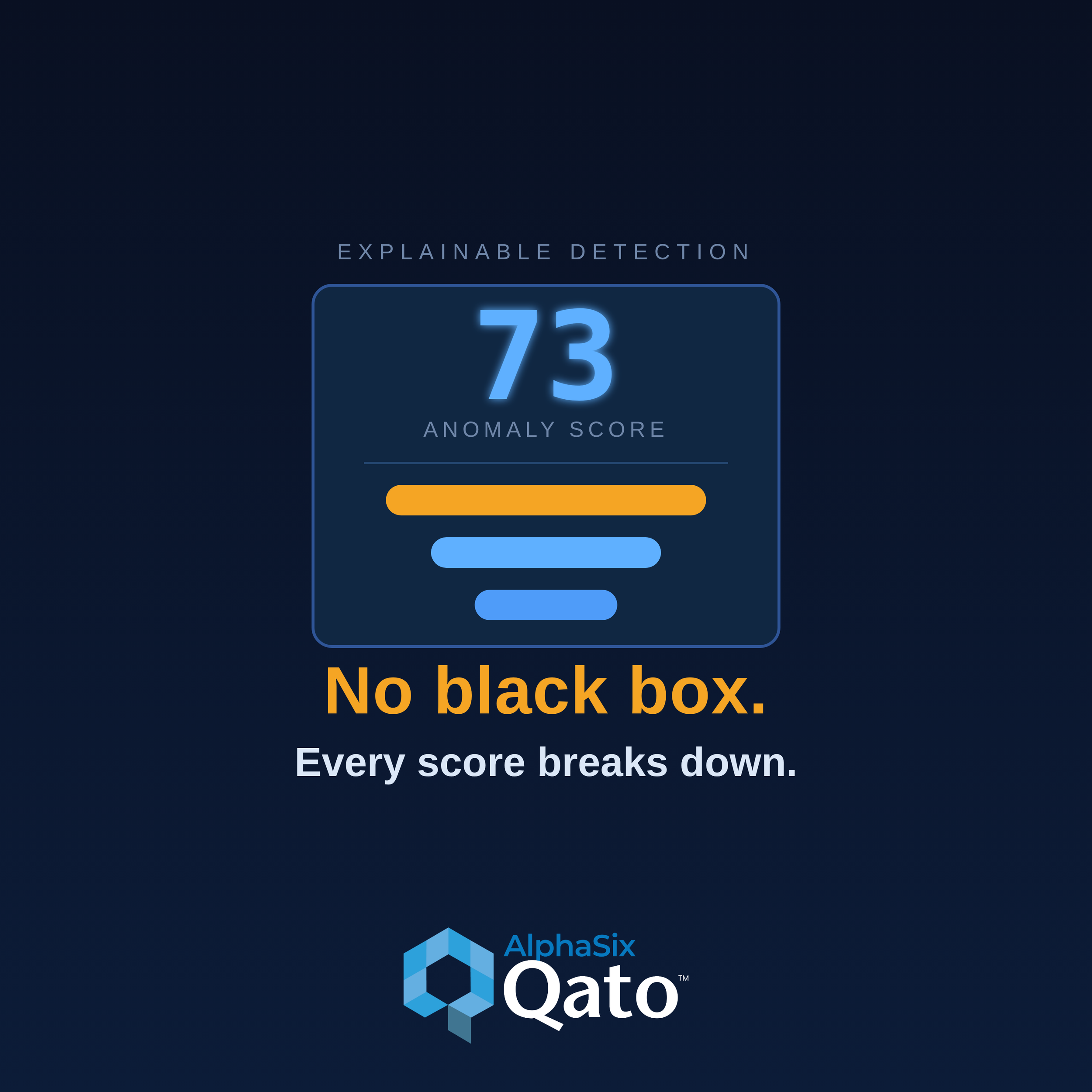
Qato scores a host by measuring how far its recent behavior has drifted from its own learned baseline, one metric at a time. Because the score is assembled from those measurements, it comes apart the same way. An anomaly that scores 73, to use an illustrative number, is not a verdict. It is a sum: SSH connections running 4.2 standard deviations above this host's normal, a jump in process creation, more listening ports than the host usually shows at that time of day, each contributing its own share of the total. The analyst does not get a number to trust. They get the specific behaviors that moved, in the host's own terms, and they decide what to do with their eyes open.
That difference pays off at every later step. The escalation has a reason attached. The shift handover is a sentence, not a shrug. The incident report writes itself from the breakdown. And when the deviation is benign, the analyst can usually see that too, because a scheduled backup or a software rollout has a behavioral shape an experienced person recognizes once it is laid out.
Where AI fits, and where it doesn't
None of this means AI has no place. It means AI should earn its keep without asking for blind trust.
Qato includes an optional assistant, QAssistant, that helps an analyst work the queue faster. It runs locally, on your own hardware, and it is model-agnostic, so you choose the model and your evidence never leaves the network. When an analyst asks it to look at an anomaly, it returns one of two recommendations: ROUTINE, meaning it found a plausible ordinary explanation, or REVIEW, meaning it could not, and a person should look closer. A safety override forces a REVIEW recommendation when the deviation is large enough, so the assistant cannot wave off a statistically significant event. The verdict is always a suggestion. The analyst keeps the final word.
The order matters there. Qato decides what is anomalous using statistics that are fully explainable. The assistant only trims the time it takes a person to sort the queue. The math is the detection. The model is a convenience, one that runs on your hardware, under your control, with the analyst above it.
Qato does not replace the SIEM or the rules your team has tuned, and it does not ask you to swap one black box for another. It adds a detection layer whose every score you can take apart, because an alert you can explain is an alert you can act on, and an alert you cannot is just one more thing to argue about.
Beyond signatures. Beyond rules. Detect the unknown.